The electricity supply chain is made up of substations that have the function of lowering high-voltage electricity to levels suitable for homes and commercial buildings. Among other things, substation safety and operation is based on an efficient grounding system called an earthing system. It directs fault current away from equipment and personnel.
Different earthing systems are used in substations such as bare copper wires or rod electrodes. Nevertheless, earth mats are commonly used when there’s a need for extensive grounding because they have some advantages over other systems.
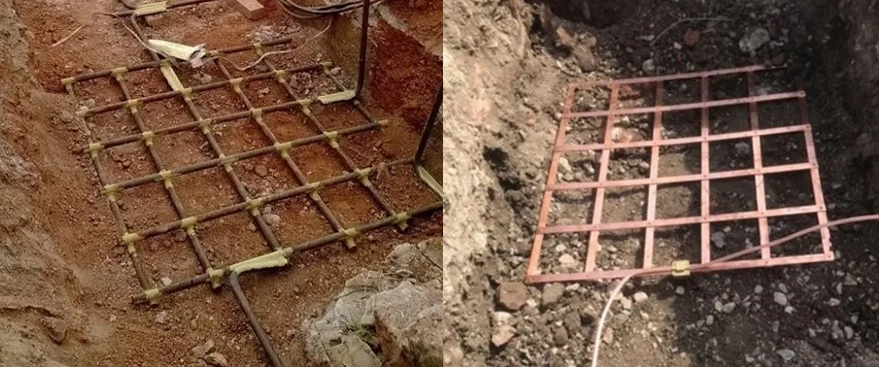
An earth mat is a network of interconnected conductors buried horizontally at a shallow depth below the substation footprint. These conductors are typically made of copper or steel and are designed to disperse fault currents efficiently into the surrounding soil.
The earth mat system also includes risers which are vertical conductors connecting the buried mat to the substation equipment and other grounding points. All these components are securely bonded together to create a uniform equipotential zone around the substation.
Reduced space requirement: Compared to rod electrodes or deep trenches, earth mats can achieve a lower grounding resistance within a limited space, making them ideal for compact substations.
Improved safety: The extensive surface area of an earth mat ensures a more uniform distribution of current, significantly reducing touch and step voltages within the substation.
Lower grounding resistance: A well-designed earth mat system can achieve a significantly lower grounding resistance compared to other methods, enhancing overall safety and equipment protection